
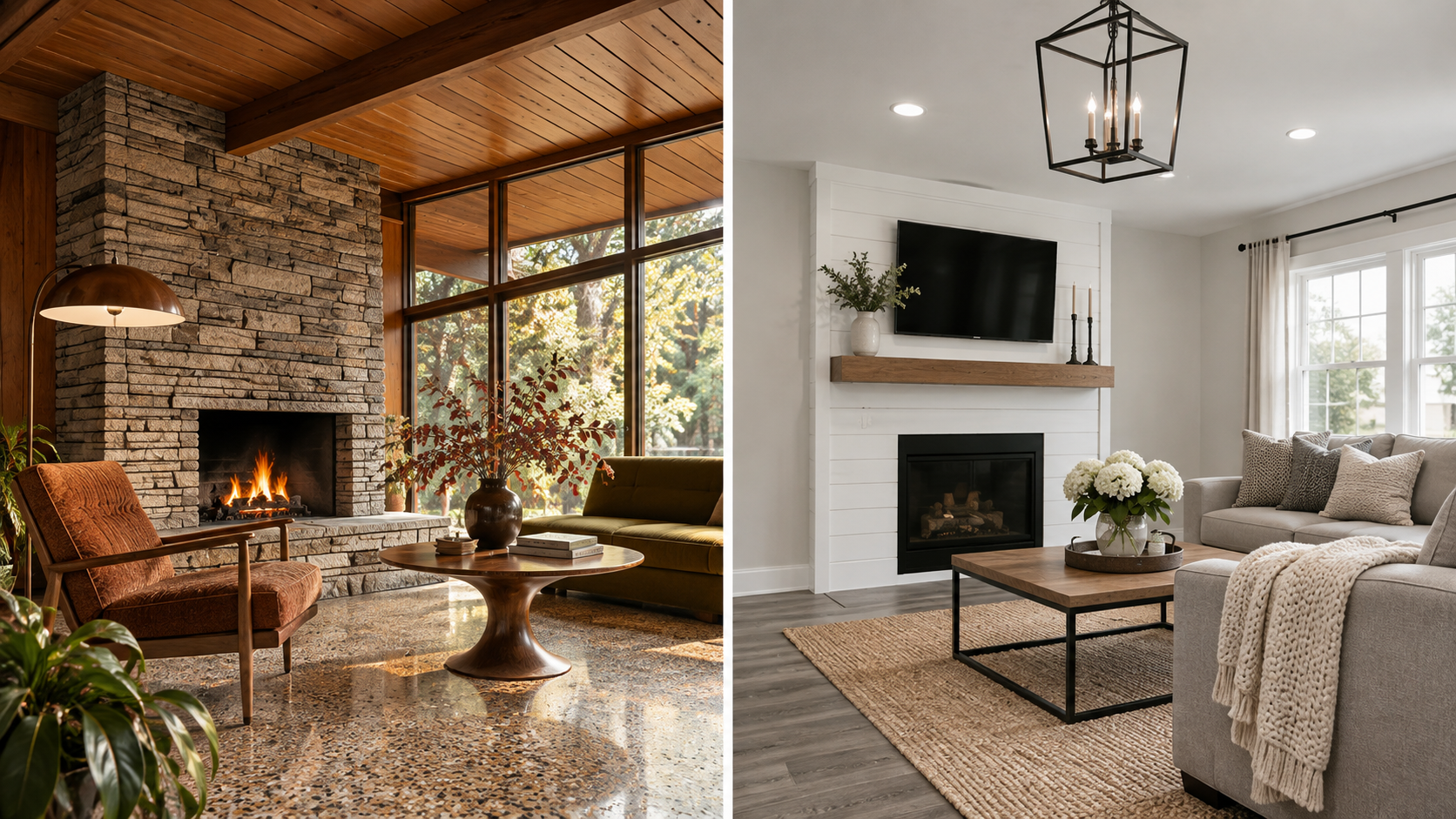
Somewhere between the white kitchen, gray flooring, and black-framed windows, individuality quietly left the building.
There was a time when you could walk into a house and learn something about the people who lived there.
Perhaps it was the wallpaper someone loved enough to hang, the unusual tile in the entryway, or a dining room painted a color that would send today’s real estate agents into a mild panic.
Not everything was beautiful. Some of it was downright questionable. But at least it was interesting.
Today, an astonishing number of houses appear to have been renovated by the same imaginary homeowner.
White cabinetry. Pale countertops. Gray flooring. Black hardware. A predictable assortment of neutral furnishings arranged around a television mounted above the fireplace.
The houses may be thousands of miles apart, built in different decades and entirely different architectural styles. Yet somehow, they all arrive at the same destination.
How did we get here?
The Resale Value Religion
Somewhere along the way, we began decorating our homes for people who don’t live in them.
The familiar advice is to neutralize, depersonalize, and eliminate anything that might discourage a hypothetical future buyer.
There is some logic to this. Buyers need to imagine themselves living in a house.
But when resale becomes the guiding principle behind every decision, something peculiar happens. The house stops reflecting the people who own it and starts resembling a product designed for the widest possible audience.
Original wood cabinetry is painted white. Distinctive tile disappears beneath something more contemporary. Architectural details are removed because they look dated.
The irony is that many of these features were once considered desirable enough to install in the first place.
And some were made with materials and craftsmanship that would be expensive to reproduce today.
The Renovation Assembly Line
Social media didn’t invent design trends. It simply made them travel faster.
A particular kitchen becomes popular. Its finishes appear in renovation videos, model homes, product advertisements, and eventually thousands of ordinary houses.
Before long, what began as one design choice becomes an expectation.
Consider the American ranch house.
Many midcentury examples were designed around long horizontal lines, generous windows, natural materials, and a strong connection between indoor and outdoor spaces.
Yet renovations sometimes replace those characteristics with details borrowed from entirely different architectural traditions: oversized farmhouse fixtures, decorative gables, or windows whose proportions have little relationship to the original design.
The result may be new, expensive, and impeccably finished.
It may also make considerably less architectural sense than what was there before.
A 1920s Craftsman bungalow, a 1960s ranch, and a contemporary house do not need the same kitchen, windows, or flooring.
Their differences aren’t obstacles to overcome.
They’re the starting point.
When Character Becomes a Defect
Perhaps the strangest part of renovation culture is how easily a perfectly good material becomes undesirable simply because it reveals when a house was built.
Consider terrazzo.
Once common in midcentury homes and commercial buildings, traditional terrazzo combines stone or other aggregates with a binding material to create a durable surface that can often be restored through grinding and polishing.
Yet original terrazzo has sometimes disappeared beneath carpeting, vinyl, or other flooring installed to satisfy changing tastes.
Or consider the colorful ceramic tile found in many midcentury bathrooms.
A well-preserved bathroom with original tile, thoughtful proportions, and functioning fixtures may offer more architectural integrity than a replacement finished entirely in fashionable neutrals.
That doesn’t mean every pink bathroom deserves preservation or every wood-paneled room is a masterpiece.
Age alone doesn’t confer beauty, quality, or usefulness.
But neither does novelty.
A well-made cabinet doesn’t become poorly made because its finish is unfashionable. A beautifully proportioned room doesn’t lose its proportions because its colors belong to another decade.
Sometimes the most intelligent renovation decision is recognizing what is already working.
The Difference Between Updating and Erasing
Houses need maintenance. Kitchens wear out. Bathrooms develop problems. Families change, and homes must accommodate them.
There is nothing inherently wrong with renovation.
The question is whether the changes actually improve the house.
Replacing damaged plumbing is an improvement. Correcting a dysfunctional floor plan may be an improvement. Restoring deteriorated windows or upgrading inefficient systems can make an older home considerably more comfortable.
Removing original architectural details simply because they aren’t currently fashionable is a different proposition.
Before replacing something, consider what it contributes.
Is the material durable? Is the craftsmanship worth preserving? Does the feature belong to the architecture? Could it be repaired, restored, or adapted?
And perhaps most importantly, will the replacement genuinely be better?
These aren’t merely sentimental considerations.
Quality materials are expensive. Skilled labor is expensive. And architectural details that are casually discarded can be surprisingly difficult to reproduce.
The cost of renovation isn’t limited to what we spend.
Sometimes it includes what we lose.
A House Should Have Something to Say
The most memorable homes aren’t necessarily the most expensive, fashionable, or perfectly coordinated.
They’re the ones that feel like someone actually lives there.
A collection assembled over decades. An unexpected color in a small room. Furniture that doesn’t match but somehow belongs together.
A house that acknowledges its own history rather than pretending it was built yesterday.
There is room for contemporary design, new materials, and fresh ideas. There should always be.
But there should also be room for individuality.
A home doesn’t need to be preserved in amber. Nor does it need to surrender every recognizable feature in pursuit of the next acceptable aesthetic.
It simply deserves to be considered on its own terms.
Perhaps the most valuable thing about a house is the part nobody else thought to put in theirs.
Piper Janie — What survived the edit.