
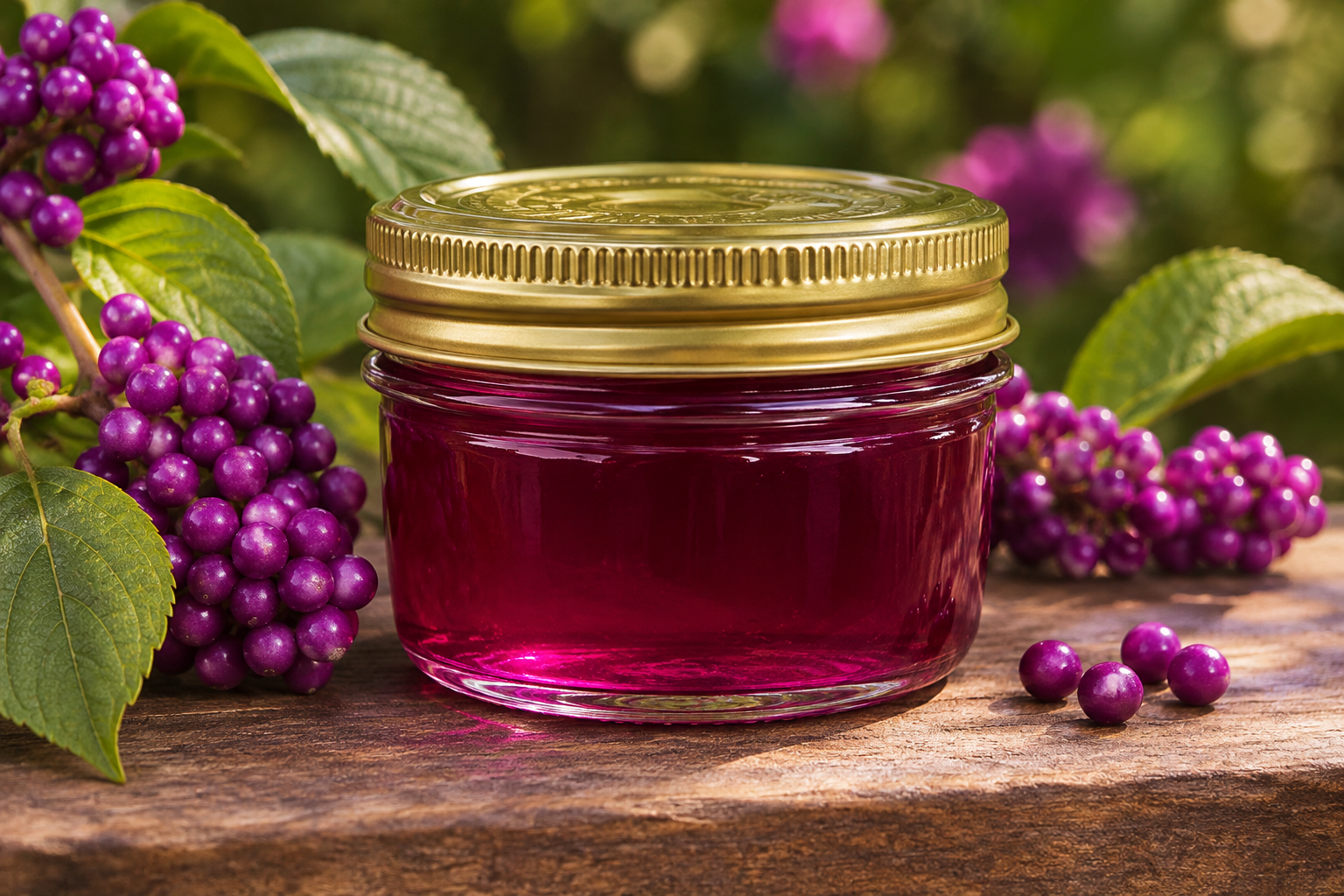
American beautyberry deserves a place in the Southern garden—and perhaps in the kitchen.
There are few plants in the Southern landscape quite as unapologetic as American beautyberry.
For much of the year, Callicarpa americana is an unassuming native shrub with arching branches and soft green foliage. Then, as summer gives way to autumn, clusters of brilliant purple berries appear along its stems.
Not a subtle lavender. Not a tasteful mauve. Purple so vivid it almost looks invented.
And here’s something many gardeners don’t realize: those berries are edible.
A Southern Native Hiding in Plain Sight
American beautyberry grows naturally throughout much of the southeastern United States, including Georgia. It is equally at home along woodland edges, in open forests, and in gardens that allow plants a little freedom.

Its graceful, arching branches generally reach three to six feet, occasionally more. In summer, small pinkish flowers appear where the leaves meet the stems. By late summer and autumn, those flowers have given way to the berries that make the shrub so distinctive.
The fruit is an important seasonal food source for birds, including mockingbirds and cardinals.
For gardeners, beautyberry offers something particularly appealing: an extraordinary autumn display without requiring an elaborate planting scheme.
Give it partial sun, reasonably well-drained soil, and enough space to develop its natural shape. Once established, it’s relatively undemanding.
And please, don’t shear it into a meatball.
But What Do Beautyberries Taste Like?
Here is where appearances and expectations part company.
For all their spectacular color, raw beautyberries have a fairly restrained flavor. Depending on ripeness and individual taste, they can be mildly sweet, somewhat astringent, or almost bland.
They’re not a substitute for blueberries or blackberries, and nobody should plant a beautyberry expecting bowls of delicious fresh fruit.
Their culinary appeal emerges when they’re cooked and combined with other ingredients.
Beautyberry jelly is a traditional Southern preparation. The berries are simmered in water, strained, and the resulting liquid is combined with sugar, lemon juice, and pectin.
The finished jelly has a delicate flavor and an especially attractive color.
Beautyberries can also be used to make syrups for beverages and desserts.
The distinction matters: this is an interesting edible native plant, not a forgotten commercial fruit crop.
From Garden to Kitchen
Harvest beautyberries when they’re fully colored and ripe, generally from late summer into autumn in Georgia.
Select clean, healthy fruit from plants that haven’t been treated with pesticides. Wash the berries thoroughly and remove leaves, stems, and debris.
For jelly, the usual approach is to simmer the berries in water, strain the liquid, and prepare the jelly with an appropriate tested recipe.
Because reliable, research-tested home-canning instructions specifically for beautyberry jelly are limited, refrigeration or freezing is preferable to assuming an improvised recipe is safe for shelf-stable storage.
And as with any unfamiliar wild food, correct identification is essential. American beautyberry should not be confused with unrelated plants bearing similarly colored fruit.
Beauty That Gives Something Back
Perhaps the most compelling thing about beautyberry is that its usefulness doesn’t come at the expense of its appearance.
It provides flowers for insects, fruit for wildlife, and an unusual seasonal ingredient for an adventurous kitchen. Its berries can also make striking additions to autumn arrangements.
But even if you never harvest a single berry, the shrub earns its place.
There is something wonderful about a plant that spends most of the growing season minding its own business, then produces one of the most astonishing displays in the Southern garden.
And the possibility of making a little jelly from it?
That’s simply a bonus.
Piper Janie — What survived the edit.