
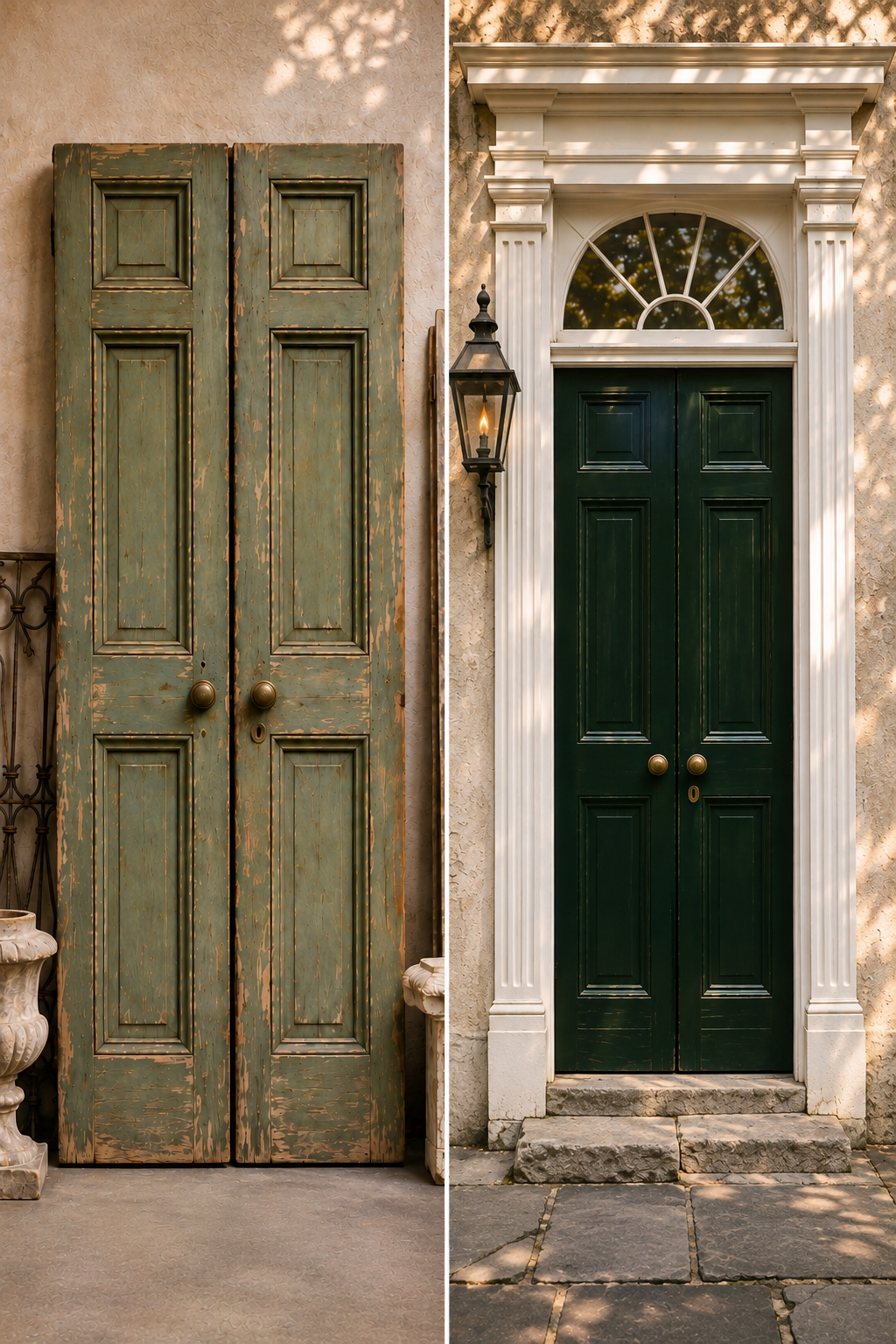
On narrow double doors, architectural salvage, and the difference between age and imitation.
There is something wonderfully self-assured about a pair of narrow old doors.
Not the enormous double doors designed to announce a house’s square footage. The opposite, really. Two tall, slender wooden leaves, meeting neatly in the middle, with just enough brass hardware to make opening them feel like an occasion.
Charleston, South Carolina, is particularly good at reminding us that an entrance needn’t be enormous to be memorable. And once you’ve noticed those beautifully proportioned doors, it’s difficult to look at a standard builder-grade entrance quite the same way.
Proportion Before Grandeur
A narrow pair of doors creates a different rhythm from a single broad slab. The vertical lines draw the eye upward. Repeated panels establish symmetry. The meeting stile—the edge where the two leaves come together—becomes part of the design.
Sometimes there is a transom above. Sometimes a handsome surround or an old stone threshold below. But the doors themselves do most of the work. Their appeal isn’t necessarily ornament. It’s proportion.
What Salvage Preserves
An architectural salvage yard can be an extraordinary place to discover what earlier buildings considered worth making.
Old doors may retain mortise locks, porcelain knobs, brass escutcheons, hand-fitted joinery, or layers of paint accumulated over decades. Even the marks left by previous hinges tell part of the story.
These aren’t imperfections that need to be manufactured. They’re evidence of use.
There’s a considerable difference between a door that has weathered a century and a new one attacked with sandpaper to suggest it has.
The Trouble With Making Old Things Fit
Of course, rescuing an old door is easier than installing one.
Historic doors rarely arrive in convenient modern dimensions. A matched pair may be slightly uneven. The frame may be missing. The hinges may need attention, and the original lockset might require a specialist.
Before falling in love, measure both leaves individually, check for twisting or rot, and inspect the joinery. For exterior use, weather protection, security, and the condition of the entire opening matter as much as appearance.
A good carpenter can solve many problems. But not every beautiful door belongs in every doorway. Sometimes the better choice is to preserve the original entrance and find another place for the salvaged pair.
Not Every Old Door Needs Stripping
There is a temptation to remove every layer of paint until bare wood appears. Resist it.
Some doors were always intended to be painted. Their profiles, proportions, and craftsmanship are no less worthy for being finished in color. And surviving historic finishes can be part of their significance.
Conservation may mean stabilizing an existing finish, repairing a damaged rail, or replacing failing hardware with something sympathetic. It does not automatically mean making everything look new. Before disturbing old paint, assess potential lead hazards and use appropriate lead-safe practices.
The National Park Service encourages retaining and repairing historic wooden doors where practical, including improving their performance with maintenance and weatherstripping. Preservation and everyday usefulness aren’t mutually exclusive.
An Entrance With Something to Say
Perhaps that’s the real attraction of those narrow paired doors.
They offer a sense of arrival without demanding attention. Their beauty comes from scale, workmanship, and the simple pleasure of two perfectly considered halves.
Architectural salvage gives such doors another opportunity to be useful. But it also reminds us that beautiful building materials were once ordinary things, made well enough to survive being ordinary for generations.
Not everything old deserves saving. Some things, however, deserve another hundred years.
Further reading: Preservation Society of Charleston and National Park Service guidance on historic doors.